What is Blockchain?
If you’ve ever heard of Bitcoin, you’ve most likely heard of Blockchain. Why? Because recently it has been the central technology of cryptocurrencies (virtual currency), including Bitcoin, Ethereum.
What is Blockchain?
What is Blockchain?
Blockchain is a technology first mentioned in 1991 by researchers Stuart Haber and W. Scott Stornetta. However, it wasn’t until 2009 that it had its first real-world application. That was Bitcoin as you know it today.
If you search the name online, the search engine will provide you with a large number of articles about the technology, which is usually described as “a ledger capable of recording transactions.” Such transactions are conducted in the most efficient way possible. Now, let’s get to the heart of the matter.
Blockchain Technology
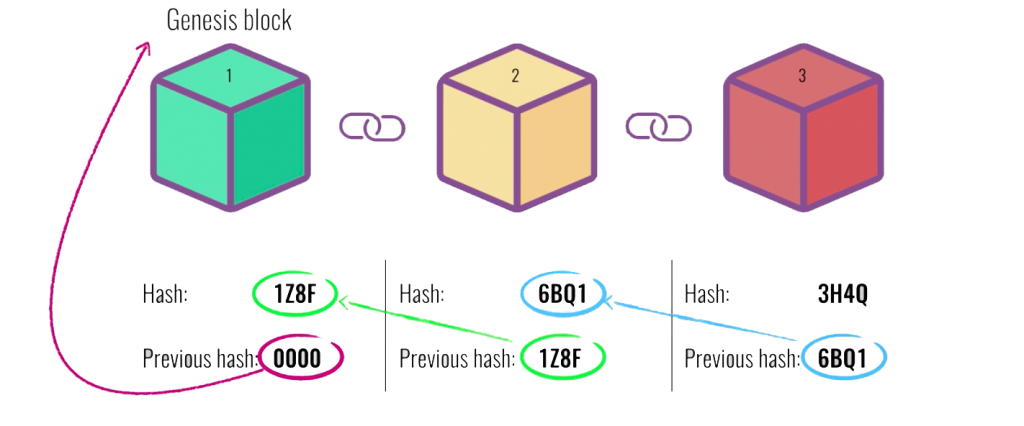
Simply put, the name Blockchain explains it. It is a technology that implies chaining blocks together.
Each block encodes any transaction performed by one party and can be uniquely identified. What is a transaction? A transaction is any exchange of value, for example, buying groceries or transferring money.
As the term suggests, each new block is connected to the previous one. The chain is irreversible, meaning no one can delete a block from it or insert a block between existing blocks.
How Blockchain Works
Four steps must be performed here:
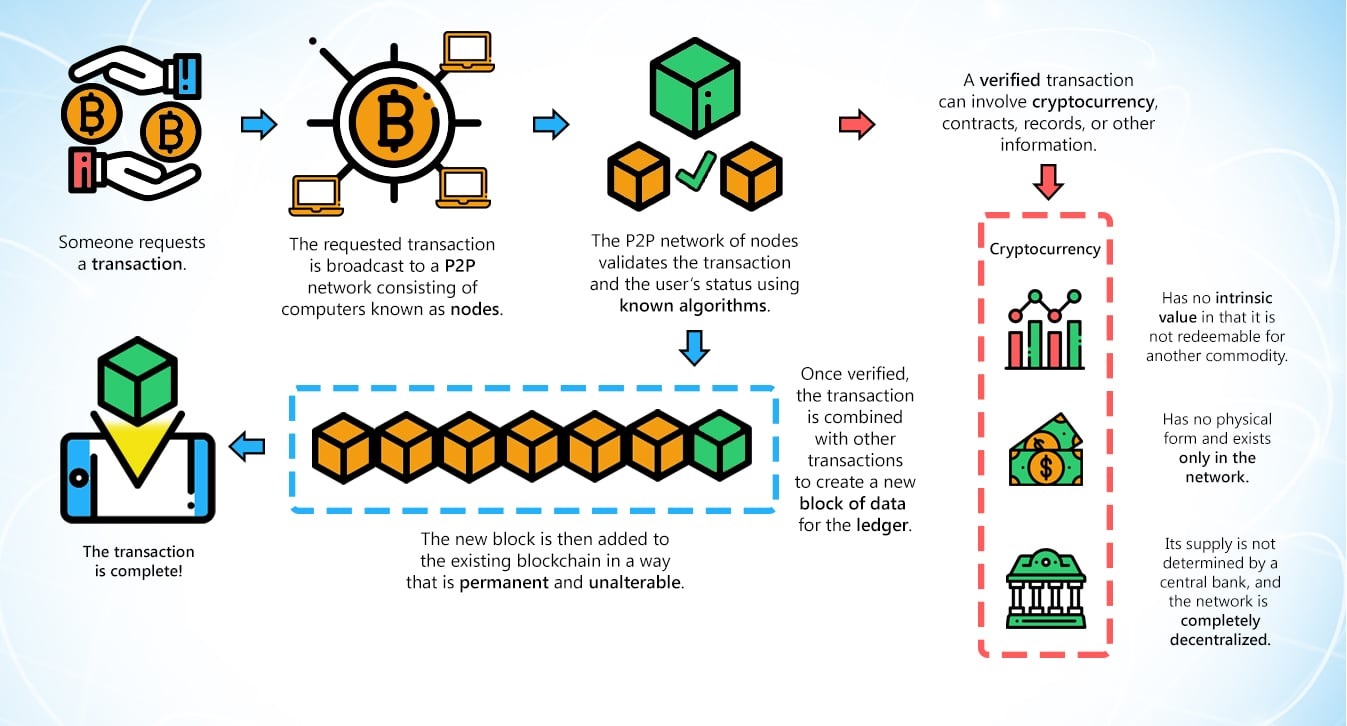
1. A Transaction Must Be Made
First, a transaction, purchase, or any exchange of value must occur to start the transaction history.
2. The Transaction Must Be Verified
A computer, or more accurately a network of computers, is activated to verify the transaction. In the case of Bitcoin, there are about 5 million computers worldwide. The computers essentially confirm the transaction details, including the time, participants, and dollar value equivalent.
3. The Transaction Must Be Encrypted in a Block
When all transactions are verified, the block storing them must be given a unique code called a hash function. Additionally, the block is also given the hash of the most recent block added to the chain. After being hashed, the new block can be added to the blockchain.
4. When the New Block is Added to the Chain, It is Ready to View Publicly
A single block is approximately 1 MB in size, so it can store thousands of transactions at once. However, it can only have one unique hash function. It should be remembered that users can choose to connect their computer to the blockchain network. If they do, their computer will receive a copy of each new block added. A computer connected in this way is called a node.
Bitcoin Transaction Cycle
Privacy of Blockchain
After all, every single block you’ve added is available for public viewing, so it’s not anonymous. However, no one can see the real names of participants because their information is stored in encoded form. The fact that each computer in the network has a copy of each block makes it difficult for hackers to manipulate the information encoded in it.
Security of Blockchain
On the other hand, how safe is it when you don’t know exactly who is adding blocks to the blockchain?
In Blockchain, a linear chain, ordered by time sequence, is used. Therefore, it ensures that each new block with data is added to the end of the chain. For example, in Bitcoin, every block has a determined position called “height.” So the new block added will have the highest value at its position. This makes it difficult to change the order of blocks. Because changing information results in a different hash, a hacker would need to change the hash code in each block that appears before it. How many years would it take a hacker to do that?
Benefits of Blockchain
Blockchain simplifies the coordination and verification process because there is always a single version of records, or in other words, a single database. In summary, blockchain has many benefits, such as security and quality assurance, making the technology quite attractive as an investment.
Future of Blockchain
It is estimated that in 2018, financial companies invested approximately $2.1 billion in research on the new impacts of Blockchain. Therefore, Blockchain is considered to have the potential to be used in many more ways than just financial transactions, but also decentralized applications, voting platforms, and even serverless internet!